This started as a article for Race Engine Technology magazine. The remit is to build a engine as it would have been in 1976, using off the shelf parts, a set of feeler gauges and a dial gauge and the engine will rev to 12,000 rpm and produce 170bhp.
Unfortuaitly its no longer going to happen
First i would like to say i am not questing physics, what i am challenging is our knowledge of the way air works in a engine, this information has been available for years, its just that some people believe air is sucked into a engine and its not, as air travels into a vacuum at 343 m/s please read on. Programs like pipemax are for dynamometer owners,and are totally different to car-calc i have never found one similar.
Car-calc is a Microsoft excel workbook that works out in seconds common engine calculations and allows you to keep everything in one place, I first wrote this program on a Sinclair Spectrum in 1981 for my local college.
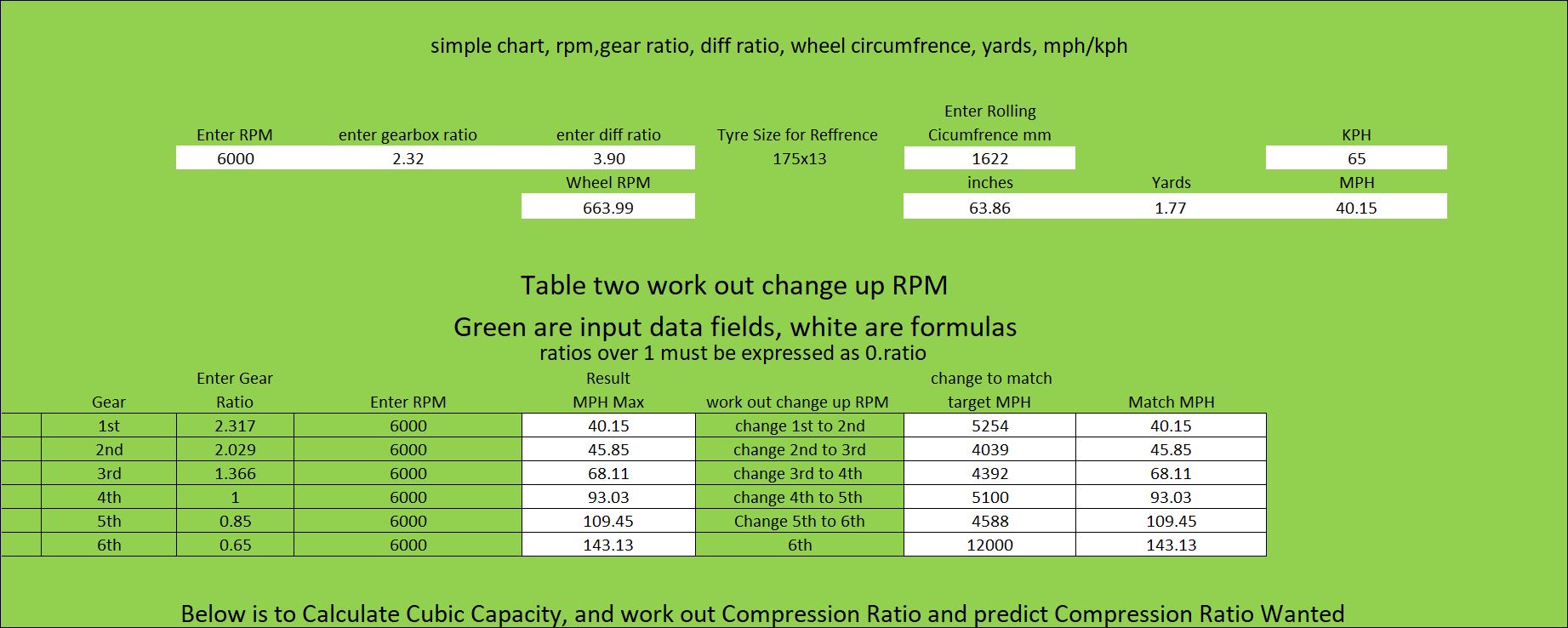
The first part in the program is to work out rpm, diff ratio, gear ratio, tyre and wheel size = MPH or KPH. This is useful when you are trying to maximise the engine revs to mph.
At the bottom is a separate sheet with all the tyre sizes, you want to copy Rolling Circumference and paste it into the box.
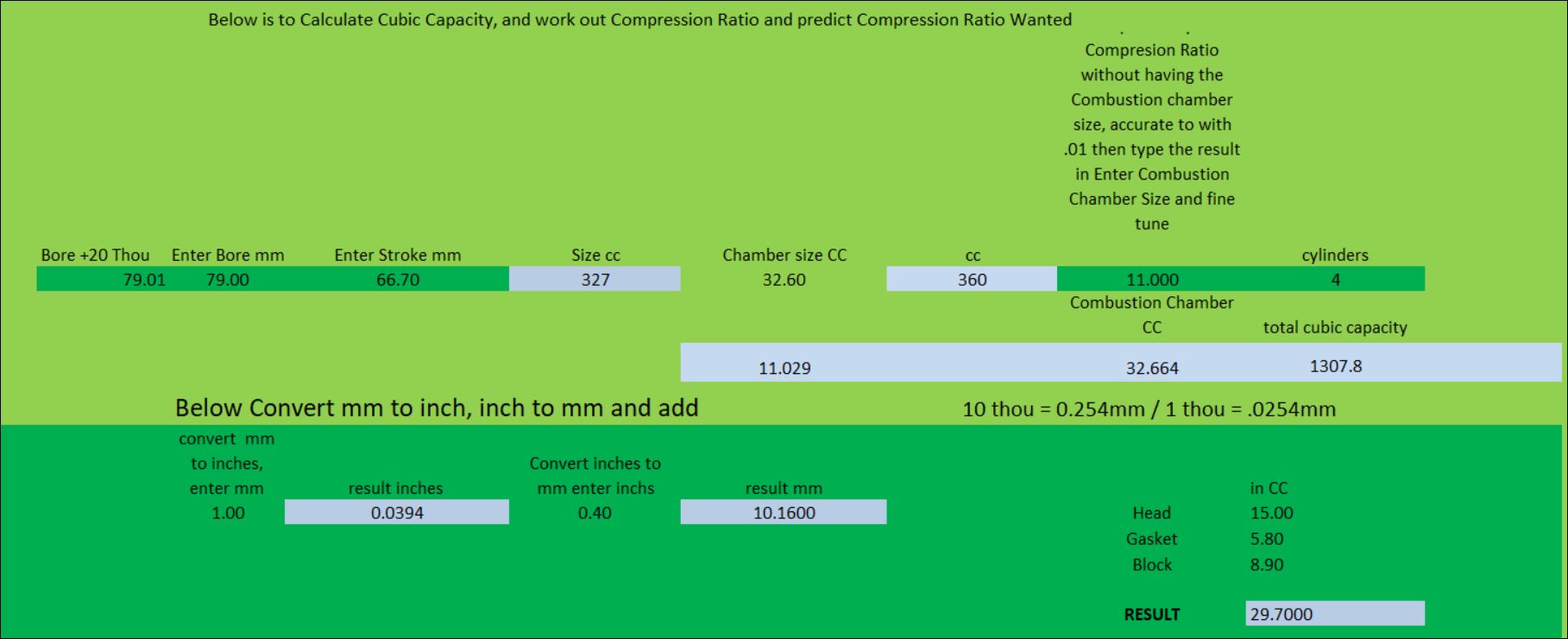
Work cubic capacity and a compression ratio predictor without having the combustion chamber size.
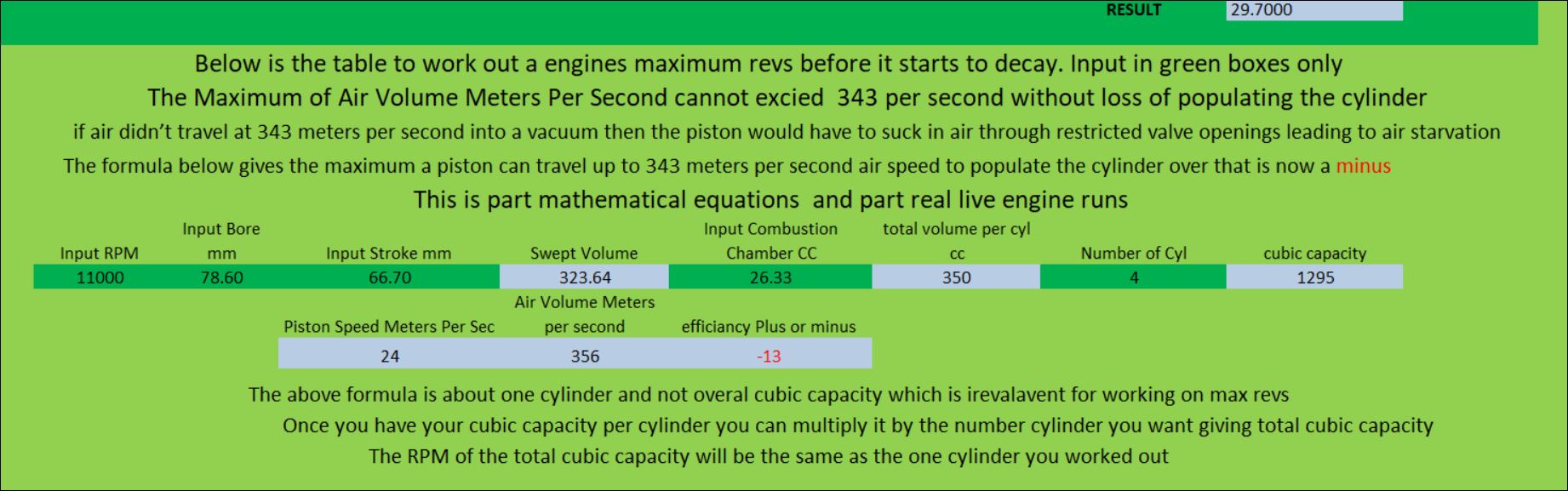
Work out what rpm your engine can rev to before it has to start sucking air in
Buy car-calc now £50
Microsoft Excel required to run
When you pay go back to
merchant
at the bottom of the page
This file can only be downloaded to a pc/laptop
Once you pay, it will take you back the merchant then download the file
and open in excel
Address
15 Stobshaw Place
Tweedbank
Galashiels
TD1 3RL
email tweedbankbill@aol.com
Phone 07918807259
car-calc is registered to William G Robertson
who owns the intellectual copy right.
car-calc.co.uk

So how does it all work
this is physics
in a simple explanation
Read on to build better engines
This article is very contentious as its people who believe air is sucked into a engine and those who know air travels at 343 meters per second into a vacuum.
Laws of physics fact,
When the downstream pressure (the vacuum) is very low compared to the upstream pressure (the air), the flow becomes "choked," meaning the flow rate is limited by the speed of sound and doesn't increase further even with a larger pressure difference.
Factors Affecting Flow Rate:
The actual amount of time it takes for air to fill a vacuum depends on factors such as the size of the chamber, the pressure of the chamber, and the size of the opening through which the air flows.
Speed of sound in air:
The speed of sound in air is approximately 343 meters per second (or 1234 Kilometres per second) at room temperature.
What does being sucked in, and what is air travels into a vacuum, in depends on several variables many explained by physics, but air travelling into a vacuum works differently as its not restricted by the same things when the air is sucked in, mainly the inlet restrictions.
A more detailed explanation by Michael Fowler
When air rushes into a vacuum, the speed is determined by the speed of sound at the prevailing temperature and pressure, not by any "sucking" action of the vacuum itself.
Pressure Difference Drives Flow:
Air flows from an area of higher pressure to an area of lower pressure, not the other way around.
Vacuum Doesn't "Suck":
A vacuum doesn't have the ability to pull air in; rather, it's the surrounding air pressure that pushes air into the vacuum.
Speed of Sound as a Limit:
The air molecules entering the vacuum will move at approximately the speed of sound at the current temperature and pressure.
Choked Flow:
When the downstream pressure (the vacuum) is very low compared to the upstream pressure (the air), the flow becomes "choked," meaning the flow rate is limited by the speed of sound and doesn't increase further even with a larger pressure difference.
Factors Affecting Flow Rate:
The actual amount of time it takes for air to fill a vacuum depends on factors such as the size of the chamber, the pressure of the chamber, and the size of the opening through which the air flows.
Speed of sound in air:
The speed of sound in air is approximately 343 meters per second (or 1234 Kilometres per second) at room temperature.
Michael Fowler
I must say what a vacuum is, when the air pressure drops below 14.7 pound per square inch, so when a piston goes down in a cylinder it creates a difference in air pressure between the cylinder pressure and the pressure outside the engine, but because air travels so fast that difference in air pressure in the cylinder will never get much under 14.7 lbs per sqr inch but its still a vacuum of 1 lbs a sqr inch, but at 10,500 rpm a 60cc stroke the piston travels at 12 mrs per second but at 10500 RPM the piston speed is 23 m/s at this speed is the max the air can travel before it takes the air longer than the piston speed resulting in the piston travelling faster than the air resulting a loss of air fuel mixture, at 11,000 rpm the air pressure will be 13.23 lbs per sqr inch which is a loss of 13% of power and it continues to lose power the higher the rpm, at 13,000 its has a loss of 78% due to air fuels starvation, but air travels at 343 m/s.
What can make a huge difference in air speed if all you require is 10,500 rpm then you can play around with the air speed, at low revs we know the cylinder is going to be filled so by reducing the inlet size by 75% and the revs 75% 2,500 rpm the air can then travel at 343 m/s 4 times the speed and much better air fuel atomisation giving more power, the ideal system would be a air restrictor between the inlet manifold and the cylinder head that can vary the restriction from semi closed at low rpm to no restriction at high rpm, this method would give max BHP and torque through the whole rev range and fuel efficiency.
What this is telling you is the speed of air entering the cylinder, the higher the speed the better to fuel air mixture atomisation, better atomisation more power. You can also experiment with inlet valve opening time, the later the faster the air flow. As a guide go to car-calc and calculate and enter the cc of one cylinder and it will tell you what you max rpm is before the engine has to start sucking air in, then use this as a guide.
Because air is relatively incompressible at low speeds, it cannot simply pile up in a narrow passage; therefore, its speed must increase to pass the same amount of air through a smaller opening (Area ×cross ×Velocity = Constant).
Air travels at 343 m/s into a vacuum, that like a high depression flowing in to a low depression we call it wind, but in a engine we are looking at flow rates at their maximum, so if air has to travel through an aperture and there is a vacuum at the other side then the air speed will be 343 m/s.
The maximum air can travel is when a plane goes faster than 1234 Kilometres per hour, it splits the air creating a vacuum and as the forces are so great to fill that vacuum the collision speed of the air is 686 M/s per second and when the gap is closed it causes a sonic boom.
At low RPM a small valve is better as the speed of the air is faster giving better atomisation more power leading up to a large valve at high RPM as it requires volume. The perfect system would be a variable size inlet, small for low RPM to large for high RPM optimising atomisation for more power over a larger RPM range. These act in a different way to the butterfly, at low RPM the aperture in the inlet would be small and the butterfly would be fully open.
The perfect adjustable air valve would be similar to what's in a camera, but to trial it cut a slot in the inlet manifold cylinder head side to take a large washer, starting with a washer with a small hole 20mm if the port size is 40mm working up to fully open, theoretically when you get the fuel mixture correct at say 2,500 rpm everything points at increased torque and BHP. Another way is to ajust the camshaft timing so valve opens full at 135 degree ATDC, this will have the same effect as reduced intake
There is a test you can do to see air working at atmospheric pressure, with piston fitted and the cylinder head fitted with valves closed try to pull the piston to the bottom of the bore, you will find its nearly impossible and your only pulling against 14.7 per square inch of air pressure normal atmospheric pressure.
Below car-calc screen shots